

Current challenges for communications professionals
The role of communications professionals (Communications Directors, Internal Communications Managers, Communications Officers, and so on) is evolving fast under the pressure of digital transformation and shifting expectations. Internally, they must inform and engage employees while nurturing corporate culture. Externally, they steer brand image and the relationship with audiences (customers, partners, media), including via social networks and online communities. All of this unfolds in a context where responsiveness and transparency are the order of the day, particularly when facing the unexpected or a crisis.
Studies also highlight that internal communication remains a top priority for organisations: according to a study by the Observatoire Intranet et Digital Working, streamlining internal communication is cited among the top three digital challenges facing companies, mentioned by 52% of organisations surveyed, just behind improving operational efficiency (Observatoire Intranet et Digital Working, 2021). Effective internal communication improves productivity and cohesion: it supports decision-making, aligns teams around strategy, reduces errors and turns employees into the organisation’s first ambassadors. At the same time, with the spread of remote and hybrid working since the pandemic, maintaining connection and corporate culture has become critical: the Baromètre Paris Workplace Ifop-SFL indicates that 36% of remote workers say they often feel isolated, compared with just 19% among those who never work remotely (Baromètre Paris Workplace Ifop-SFL, 2019). Communications professionals therefore need to innovate (social intranets, phygital events blending in-person and digital formats, and so on) to meet these new needs.
Externally, communications departments face a proliferation of channels and a wide range of audiences that need to be informed consistently. They aim to build genuine communities around the brand (loyal customers, partners, internal or external influencers) to strengthen trust and loyalty. Finally, information security is a growing concern: whether protecting sensitive announcements internally (e.g. reorganisations) or securing communications during a crisis (cyberattack, reputational crisis), communicators must ensure digital exchanges remain confidential and under control. This challenge has been further reinforced since the European Parliament reinstated the Chat Control regime on 9 July 2026: organisations exchanging sensitive information now have yet another reason to question the genuine sovereignty of their messaging tools. In this context, adopting a sovereign and secure collaborative platform proves to be a strategic asset (Whaller DONJON, for instance, is the first collaborative platform in France to have been qualified SecNumCloud).
The facts and figures
The sections below explore several aspects of the communications profession and how a modern collaborative platform can provide tailored solutions.
Internal communication: informing, aligning and mobilising employees
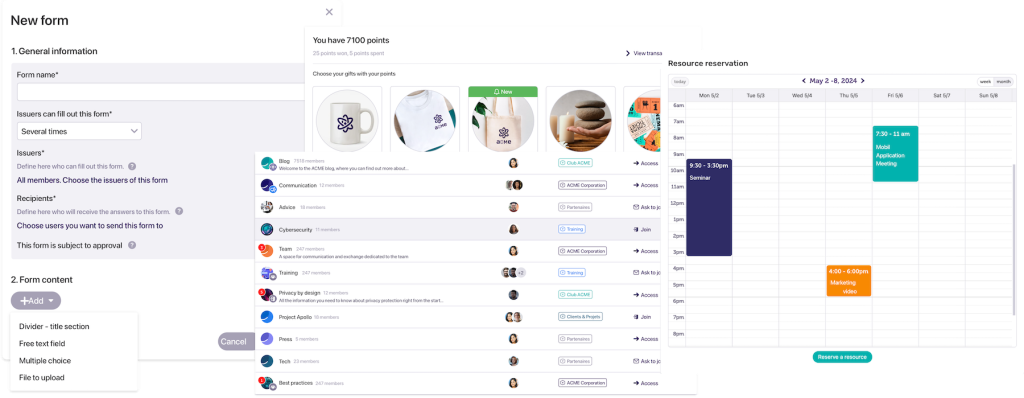
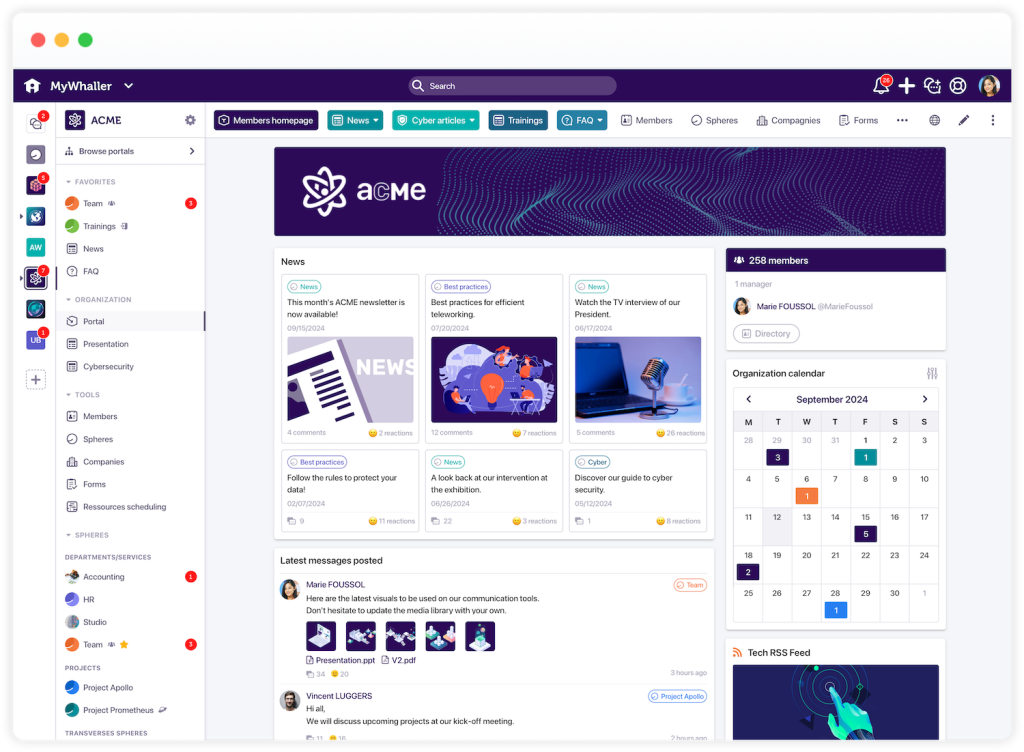
A collaborative intranet of this kind centralises access to internal communities and key resources, making it easier to navigate and share information across the organisation. Communications managers can publish news, documents or important announcements there, while targeting their messages according to audience (department, site, project, etc.). This tailored distribution ensures that every employee receives the information relevant to them, avoiding information overload and message fragmentation.
A two-way dialogue rather than top-down communication
Internal communication aims to engage employees and strengthen corporate culture. It brings teams together around shared objectives and celebrates internal successes. To achieve this, communicators have a range of digital tools at their disposal:
- an integrated content management system (CMS) for publishing and organising articles on a company portal (intranet) accessible to all, or on dedicated departmental pages;
- social and interactive features (comments, polls, real-time discussions) that create a two-way dialogue rather than classic top-down communication;
- themed or function-based spheres that allow information to flow more smoothly and be more precisely targeted: the “Internal Communication“ sphere reaches internal relays or managers specifically, while an “All Employees” sphere is used for broad, general announcements.
This approach also fosters cross-functional working: an inter-departmental topic can be handled within a shared sphere (e.g. Innovation Project 2026) bringing together everyone concerned, rather than through lengthy e-mail chains with multiple recipients copied in. According to client feedback, this centralisation can cut internal e-mail overload by up to 40% by replacing it with lively exchanges within spheres.
Producing and distributing internal content faster with AI
Whaller has recently enriched its platform with features of direct interest to communications professionals. Whaller (IA)ssistant now allows users to select articles to feature, let the AI draft an organisation newsletter, and then edit and send it in just a few clicks, directly from the platform without going through a third-party tool. The assistant can also summarise an entire conversation or unread messages following an absence, produce automatic meeting minutes, and turn decisions taken into concrete actions assigned to the right people. Thanks to its MCP server, it can now act directly within spheres to generate internal newsletters and summaries, with no manual intervention required. Going further still, the launch of Whaller Mail (June 2026) introduces a sovereign e-mail service hosted in France and natively integrated into the Whaller workspace, allowing employees to manage their e-mail within the same environment as their spheres, documents and tasks, without depending on a mailbox hosted outside Europe.
Finally, recognising internal contributions (ideas, feedback from the field) becomes much easier. Thanks to collaborative features (forums, suggestion boxes, polls), communicators can gather employee feedback, identify internal ambassadors and pick up on early warning signs. In short, a well-used collaborative platform turns internal communication into a lever for cohesion and lasting performance.
External communication and community management: shaping image and uniting the ecosystem
Communicators no longer simply broadcast messages one-way to the outside world; they seek to build genuine communities around their organisation. This involves managing public social networks, but also creating private, controlled spaces where stakeholders across the ecosystem (customers, partners, ambassador programme members, etc.) can be brought together.
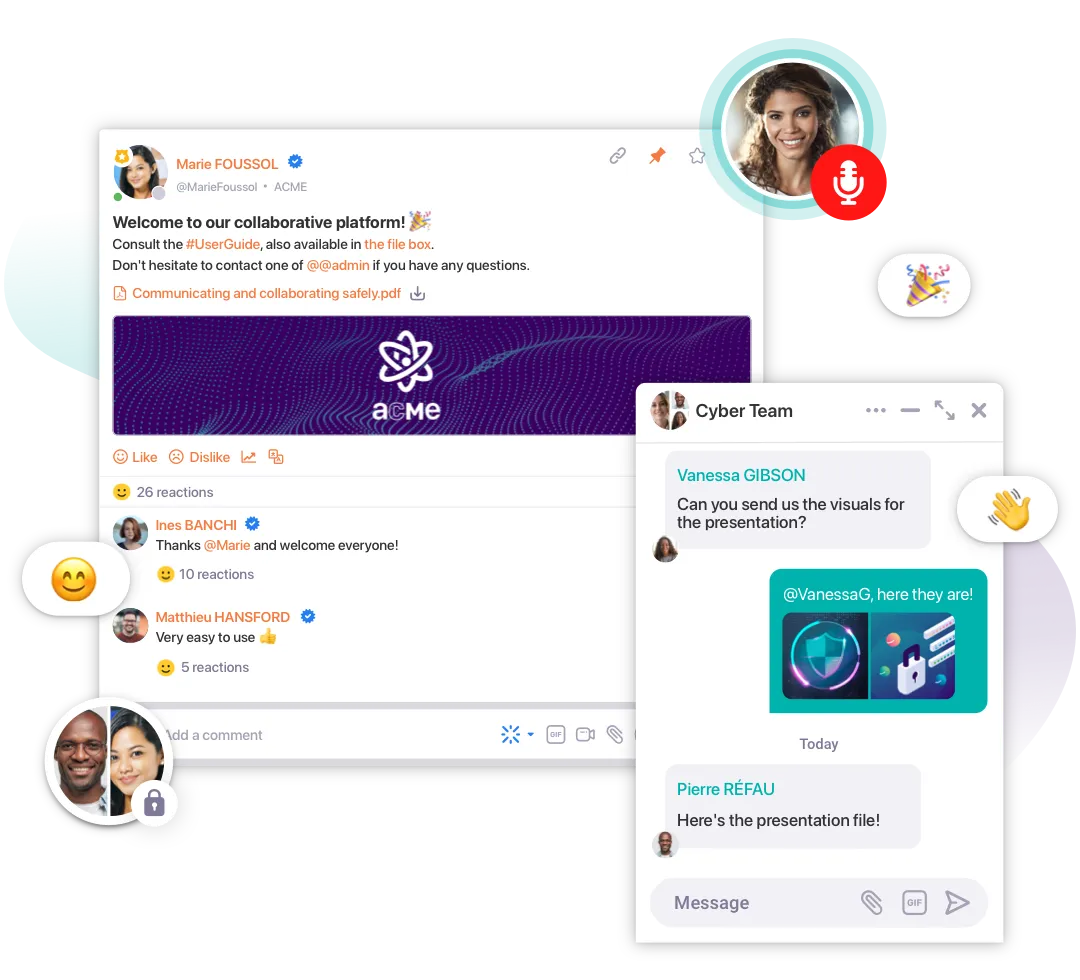
A collaborative platform makes it possible to build an enterprise social network extended to external audiences. In practical terms, the communications department can create spheres accessible to visitors (external users) or public spheres, to engage with target groups outside the organisation while retaining full control over the data. For example, a “Brand Ambassadors” sphere would allow content to be shared as a preview with VIP customers or strategic partners, and this restricted group to be engaged with dedicated news, polls, exclusive events, and more. External participants only have access to the space they are granted, ensuring compartmentalisation and confidentiality relative to the rest of the intranet. This “community by invitation” approach has the advantage of creating a stronger sense of belonging than a simple public Facebook or LinkedIn page, since the exchange is more direct and exclusive.
For communicators, running these external communities offers a dual benefit: improving the customer/partner experience by involving them more closely, and strengthening the brand by rallying a circle of active supporters. Indeed, according to an analysis of client feedback, improving internal communication and strengthening the customer relationship rank among the leading benefits gained through Whaller, a sign that the tool serves as much for internal dialogue as for better interaction with external audiences. In practice, features such as file sharing, instant messaging or integrated video conferencing make it possible to engage effectively with community members without ever leaving the platform. Content co-creation is made easier (e.g. gathering customer testimonials, moderating feedback, brainstorming new product ideas via a dedicated sphere).
The platform can also serve as a central hub for institutional external communication: via a public portal, communicators can publish news visible to everyone (press releases, newsletters, blog articles) while giving visitors the option to request to join certain communities. The result is an interactive showcase for the organisation, directing different audiences to the right spaces for engagement. Where needed, external audiences can be segmented just as they are internally (by territory, product range, language, etc.), so that targeted messages reach each community. This fine-grained control over external communication helps protect and strengthen the organisation’s online reputation: official messages are relayed through a controlled channel, and exchanges with key audiences can be monitored and moderated securely.
Crisis communication: speed, coordination and information security
Crisis communication represents a major challenge for organisations, as a poorly coordinated response can worsen the impact of an incident (whether cyber, industrial, health-related or media-driven). Experts recommend embedding the communications function at the heart of the crisis unit from the very first hours, in order to quickly deliver clear messages to the various audiences (employees, customers, media, partners, authorities, etc.). Collaborative platforms bring decisive added value here: they provide a centralised, responsive space to orchestrate all exchanges as soon as a crisis breaks out.
A single space from the very first hours
Without a unified tool, communicators handling a crisis have to juggle e-mails, calls and emergency meetings, which often leads to wasted time, duplicated information and inconsistencies in the messages sent out. With a dedicated collaborative platform, this risk is significantly reduced. For example, as soon as a crisis breaks out, the organisation can set up a special “Crisis Communication“ organisation or sphere on Whaller, bringing together all relevant stakeholders. Management, the communications team, IT/cybersecurity and legal are added straight away, along with sub-spheres for dialogue with specific external groups where necessary (journalists, affected customers, partners, etc.). Every member of the crisis unit thus gets real-time information in a single place, rather than through scattered channels.
Collaborative tools that speed up coordination
- instant messaging and notifications to alert everyone immediately of developments;
- video conferencing to hold urgent situation briefings;
- file sharing and online co-editing for drafting press releases or FAQs simultaneously, avoiding endless version back-and-forth;
- polls and forms, natively available since version 7.4.0 of the application, to quickly validate a key message before it is released;
- announcements to push urgent information out to an entire organisation without cluttering the discussion feed;
- encrypted spheres dedicated to strategic announcements, mergers and acquisitions or confidential projects, with granular access control and fine-grained rights management.
All of this takes place within a highly secure environment: hosted in France, GDPR-compliant and outside the reach of extraterritorial laws (Cloud Act, FISA), with end-to-end encryption, multi-factor authentication (MFA) and full access traceability, including for external users under an Enterprise licence.
A heightened requirement for sovereignty
This centralised approach delivers tangible results: the messages issued are consistent and validated by the entire crisis team, eliminating the contradictions that can sow doubt. Responsiveness improves as a result. In the event of a cyberattack, for instance, the collaborative platform makes it possible to maintain a tailored narrative for each audience (employees, customers, media) from distinct but synchronised spaces. The reinstatement of Chat Control in July 2026 is a further reminder to communicators that choosing a European host and legal framework is no longer a mere technical argument, but a fully-fledged component of reputational risk management. Ultimately, this set-up gives communicators a genuine control tower for crisis communication, from the initial alert right through to post-incident follow-up.
Managing communications projects: collaborating effectively day to day
Beyond these specific areas (internal, external, crisis), communicators are regularly called upon to manage cross-functional projects, such as rolling out a new marketing campaign, organising an event, or overhauling a website. These projects often involve multiple stakeholders (external agencies, various internal teams, suppliers) and numerous deliverables. Here again, collaborative platforms provide a unified working environment for running these activities in an agile way.
A single source of truth for every project
Rather than exchanging dozens of e-mails and file attachments, the communications project team can create a dedicated sphere or group where all relevant information is centralised:
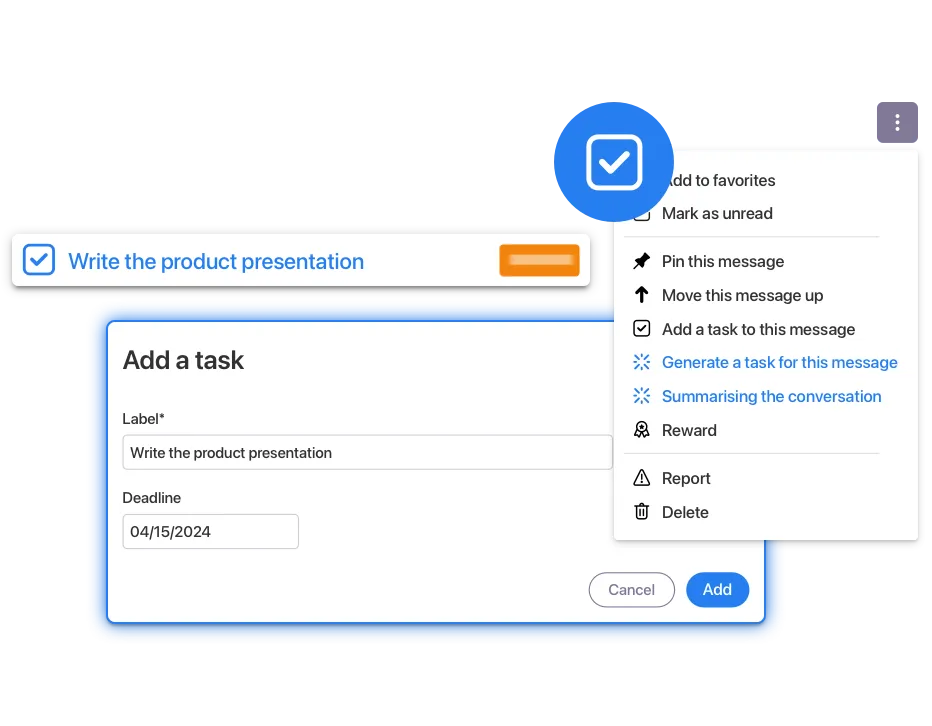
- a shared task management module (assigning owners, deadlines, checklists) that gives everyone visibility and prevents things slipping through the cracks;
- a shared calendar and automated reminders that ensure campaign deadlines are met and known to all;
- online document co-editing (press releases, presentations, visuals), which guarantees everyone is working on the latest version;
- since the launch of Whaller Mail, project-related e-mail exchanges (with suppliers, for example) remain accessible within the same environment as tasks and files, with no need to juggle between tools.
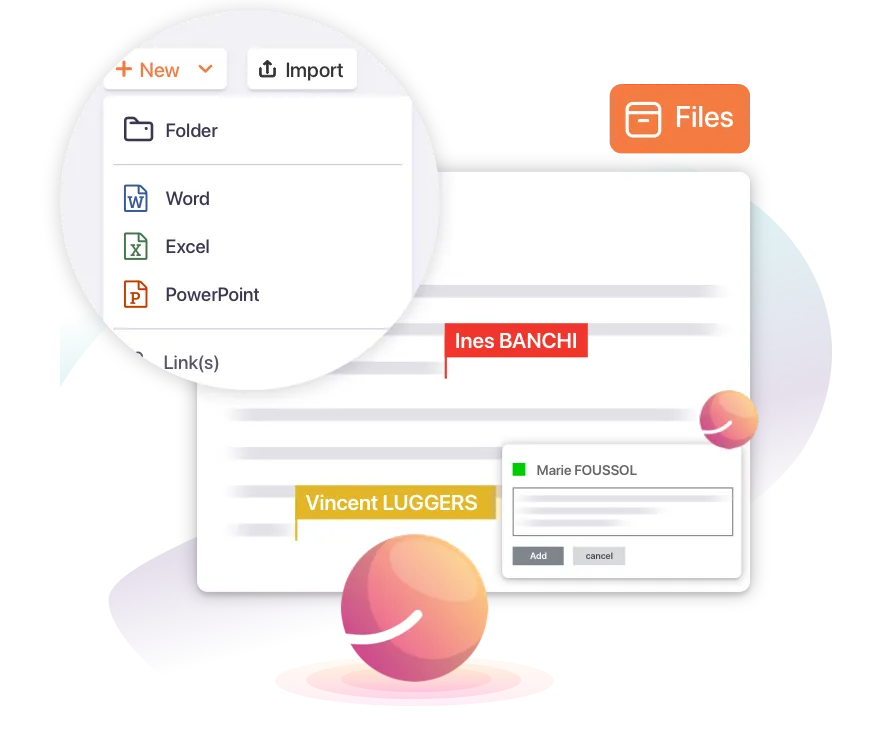
Back-and-forth with suppliers (designers, printers, PR agencies, etc.) is made easier by adding them as guests within the project sphere: they can upload their deliverables and retrieve approved materials, all without gaining access to the rest of the organisation’s network. The latest version of the Whaller application has also improved the ergonomics of discussions, navigation and message formatting, making this kind of day-to-day collaborative follow-up even easier. Thanks to the mobility on offer (apps available on all devices, push notifications), communicators can track and adjust their project in real time, even while travelling or at events. The platform retains a full history of exchanges and decisions, which is invaluable for traceability and post-project review. In short, managing communications projects becomes simpler, more transparent and more collective, including across different departments (marketing, HR, IT, wherever the project requires it).
Real-world use cases for communications teams
Seven everyday situations, and the Whaller features that address them directly.
Internal communication
Objective
Share news with everyone clearly and in a targeted way.
Push notifications
Custom banners
(IA)ssistant newsletter
Crisis unit
Objective
React quickly to the unexpected with dedicated channels.
Multi-channel alerts
Full traceability
Crisis communication
Objective
Get controlled information out quickly to each audience.
Targeted notifications
Fine-grained access control
Management/Employee link
Objective
Build connection and engagement with teams.
Moderated comments
Polls
Collaboration with agencies
Objective
Coordinate a project without exposing sensitive information.
Inter-organisation spheres
Guest status
Meetings and committees
Objective
Produce reliable minutes and tracked follow-up actions.
Task generation
Automated internal newsletter
Objective
Structure and distribute regular communication without spending hours on it.
MCP server
What Whaller delivers, in numbers
2.5x
Impact and engagement
Higher read rate than an internal e-mail on a collaborative platform.
Lecko, 2023
-30%
Clarity and consistency
Fewer internal communication errors thanks to centralised content.
Whaller client feedback
÷2
Responsiveness and mobilisation
Time taken to distribute strategic information across all teams.
IDC, 2023
76%
Credibility and trust
Of employees say they are sensitive to the security of communication channels.
Edelman, 2024
A platform committed to responsible digital technology
Choosing Whaller also means choosing a collaborative platform aligned with the values increasingly championed by communications teams towards their stakeholders:
- a Positive Workplace® labelled platform;
- eco-design and “green” hosting supporting digital sobriety;
- data hosted locally, with no exposure to extraterritorial laws;
- protection of strategic content within a sovereign, controlled environment.
In conclusion, the communications profession today relies on broader skills and collaborative tools to meet its key challenges. Whether informing employees, nurturing the organisation’s external presence, steering communication during a crisis, or managing complex projects, a modern, secure collaborative platform is a valuable ally. It offers a wealth of features (sovereign messaging, integrated AI, document sharing, video conferencing, task management, and more) in service of fluid communication and team productivity. Above all, it allows communicators to retain control over their various audiences and messages, while fostering engagement and collective intelligence. In an environment where every exchange counts, having a trusted digital space to collaborate now makes all the difference for the Communications function.
Request a personalised demonstration
Want to find out more? Explore the “Whaller Communication” role profile.
Need to go further?
Our teams are ready to work with you to build the platform best suited to your ambitions.
📅 Sign up for free | 👉 Request a demonstration | 📩 Contact us!



0 Comments