
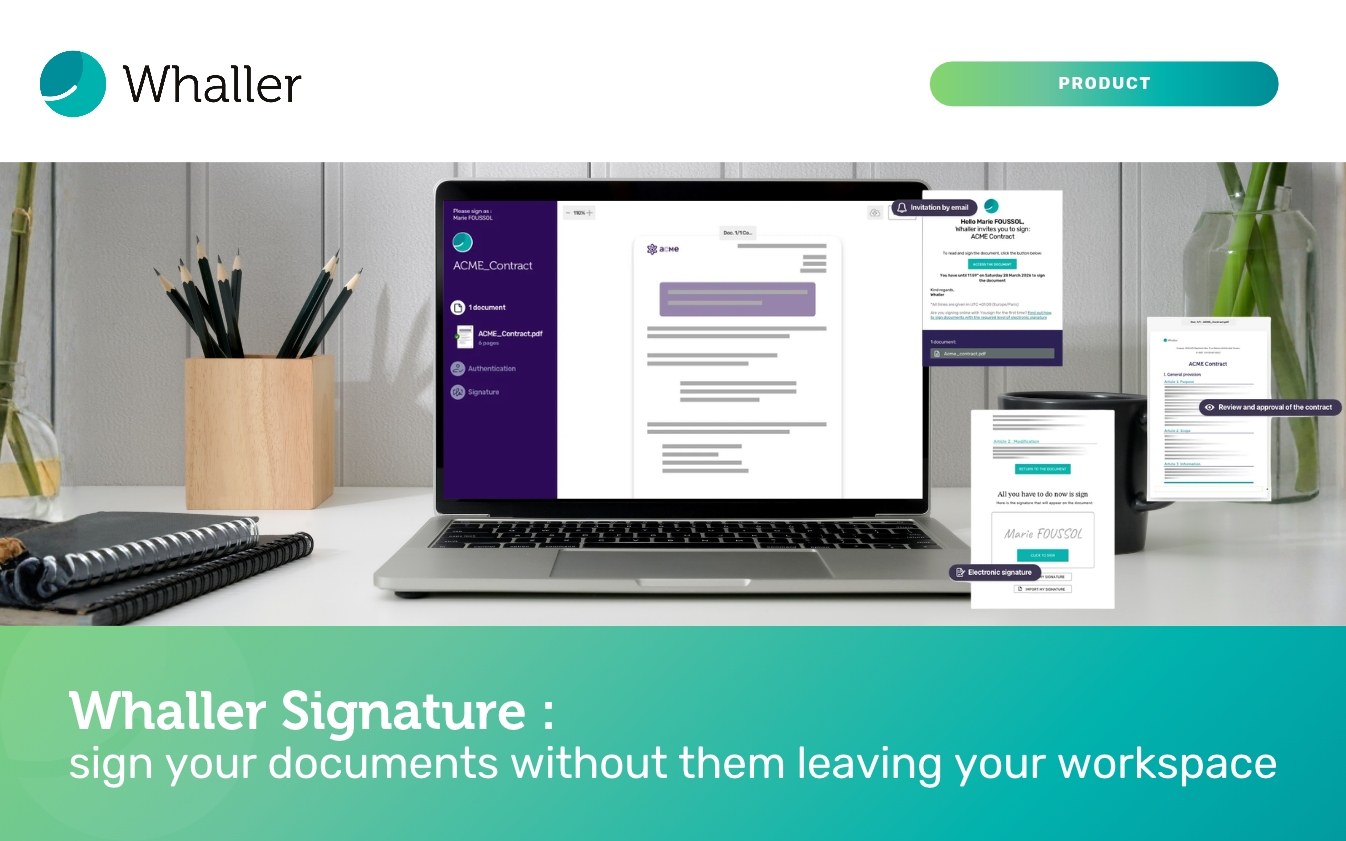
A service contract, an amendment, a partnership agreement or a simple certificate almost always follows the same route. Someone drafts the document in a word processor, several versions go back and forth as email attachments, the final draft is exported to PDF and uploaded to a separate signing service, and the signed copy is eventually downloaded and filed somewhere, in the hope that nobody is still working on an earlier version. Each time the document changes tool, it leaves a controlled environment, and it becomes harder to know who has read it, who has changed it and where it is actually stored.
Whaller Signature brings that whole journey into the workspace your teams already use. The document is stored, discussed, approved and signed in one place, and it stays hosted in France from the first draft to the archived signed copy.
What the law says: the legal value of an electronic signature
In the European Union, electronic signatures are governed by the eIDAS Regulation (Regulation (EU) No 910/2014). Article 25 sets out a simple principle: an electronic signature cannot be denied legal effect or admissibility as evidence in legal proceedings solely because it is in electronic form.
The regulation defines three levels. A simple electronic signature is suitable for everyday commitments, an advanced electronic signature provides stronger guarantees, and a qualified electronic signature, which is more demanding to implement, has the same legal effect as a handwritten one. Under Article 26, an advanced signature must meet four requirements: it is uniquely linked to the signatory, it is capable of identifying them, it is created using means under their sole control, and it is linked to the signed data in such a way that any later change can be detected.
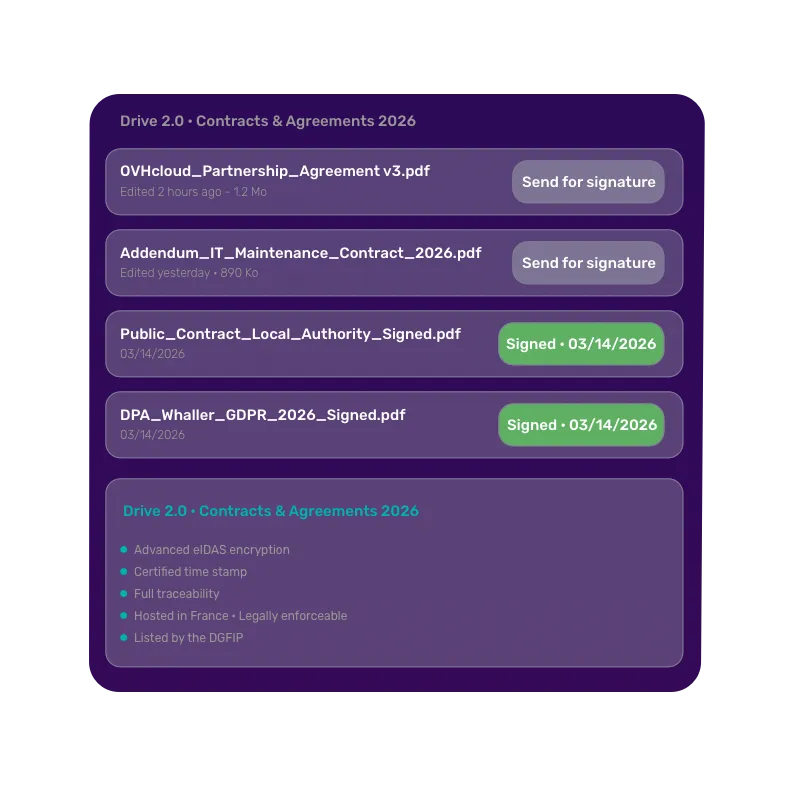
Whaller Signature provides this advanced level through a trusted French provider, certified under eIDAS and approved by the French public finances authority (DGFIP). It covers the vast majority of business needs, from commercial contracts to HR documents and public procurement paperwork.
Worth remembering: the evidential value of an electronic signature depends as much on the audit file that accompanies it as on the signature itself. Whaller Signature keeps a time-stamped audit trail of every step (sending, viewing, authentication, signing) that can be produced if the document is ever challenged.
Signing without the document leaving your environment
Legal value is only part of the picture. Contracts often contain pricing terms, personal data or strategic information, and the question of where they are hosted arises at every step. When a document passes through a service subject to the US Cloud Act or FISA, it partly escapes your control, even if the signature itself is valid.
In Whaller, the document is first placed in the relevant sphere, such as the Legal sphere or a project sphere. Authorised members comment on it, suggest changes and approve the final version without swapping attachments. It is then sent for signature in one click from Drive 2.0, Whaller’s native app for Mac and PC, and the signed copy comes back to the same sphere with its audit trail. Documents, signatures and timestamps all remain hosted in France.
The signatory’s journey, step by step
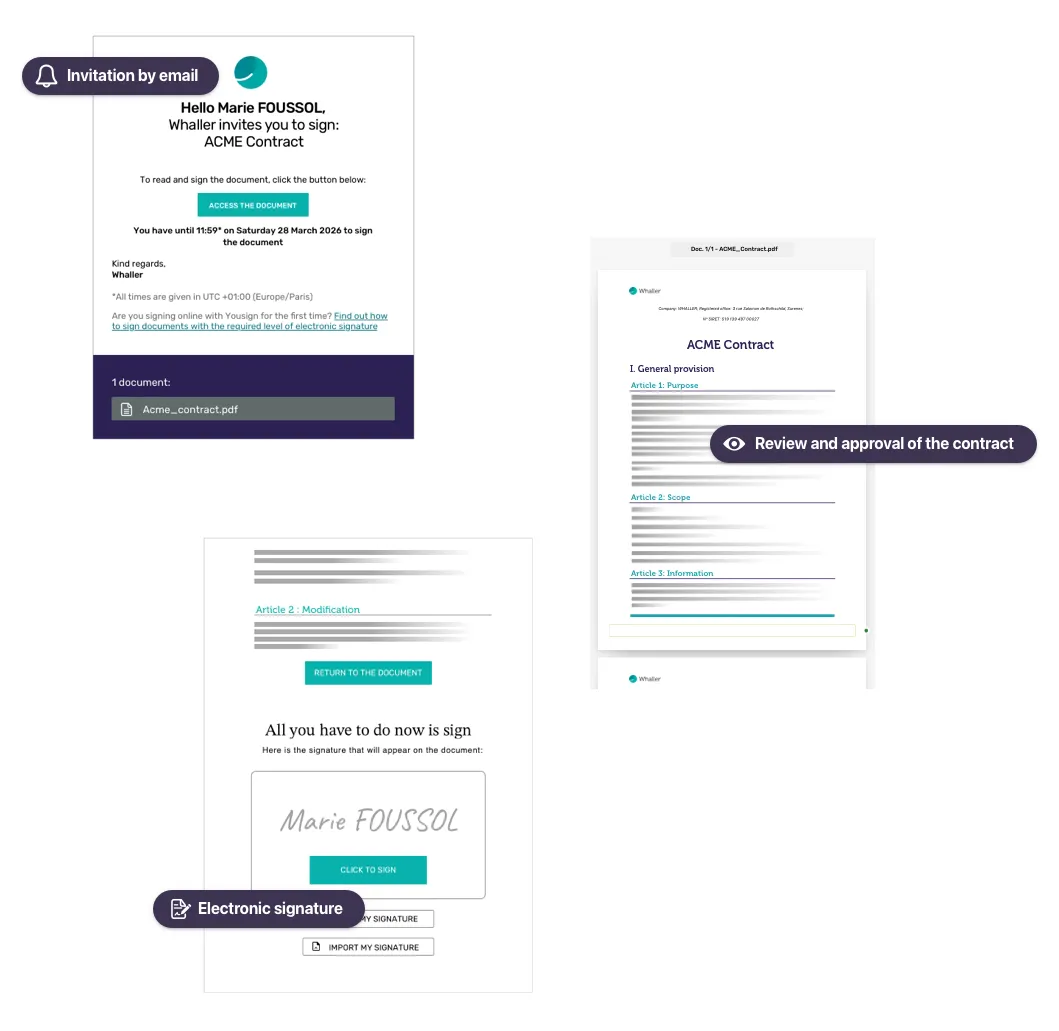
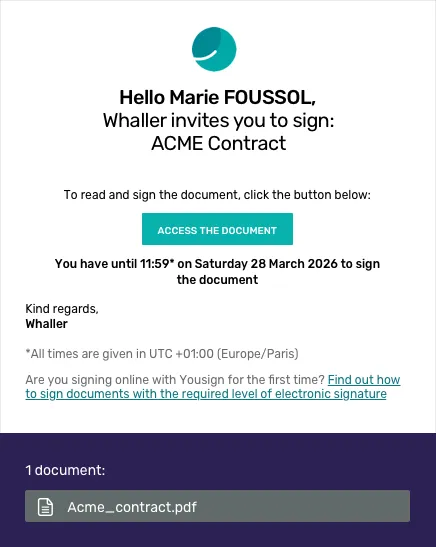
For the person signing, the journey is designed to be understood without any explanation. They receive an invitation email that names the document and the deadline, then open a landing page where they can read the whole document before activating the signature. A security code confirms their identity, they sign in a dedicated panel and see an on-screen confirmation, followed by a closing email.
 The invitation email |
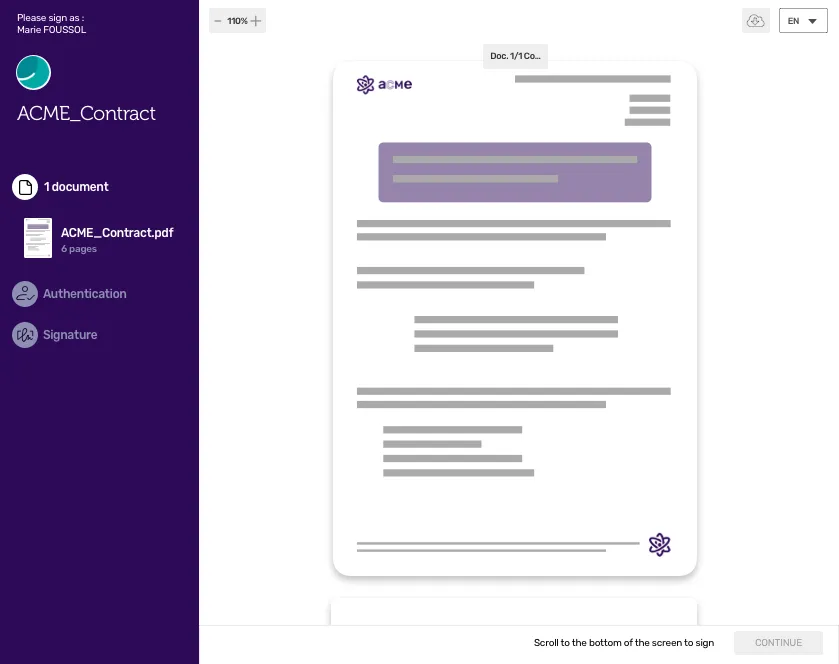 Reading the document |
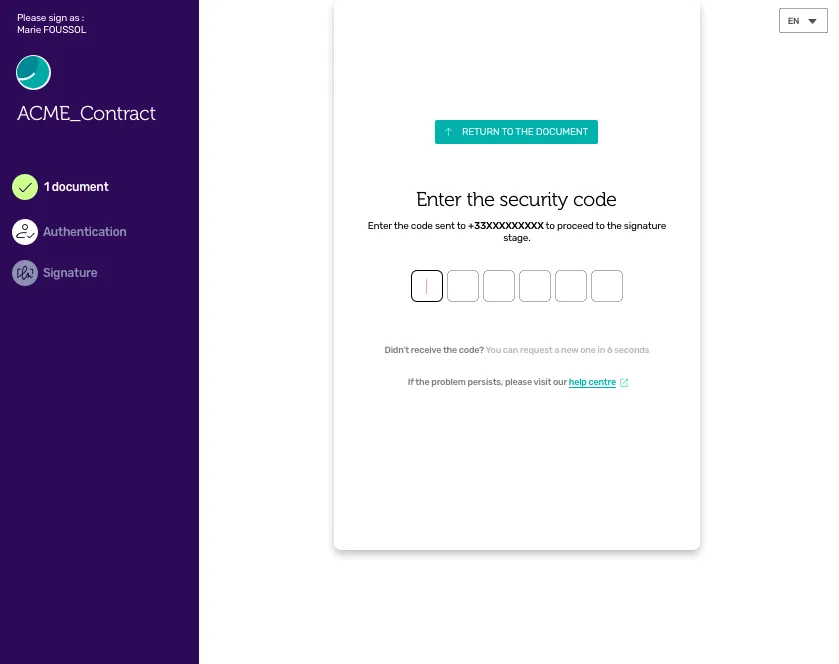 Code-based authentication |
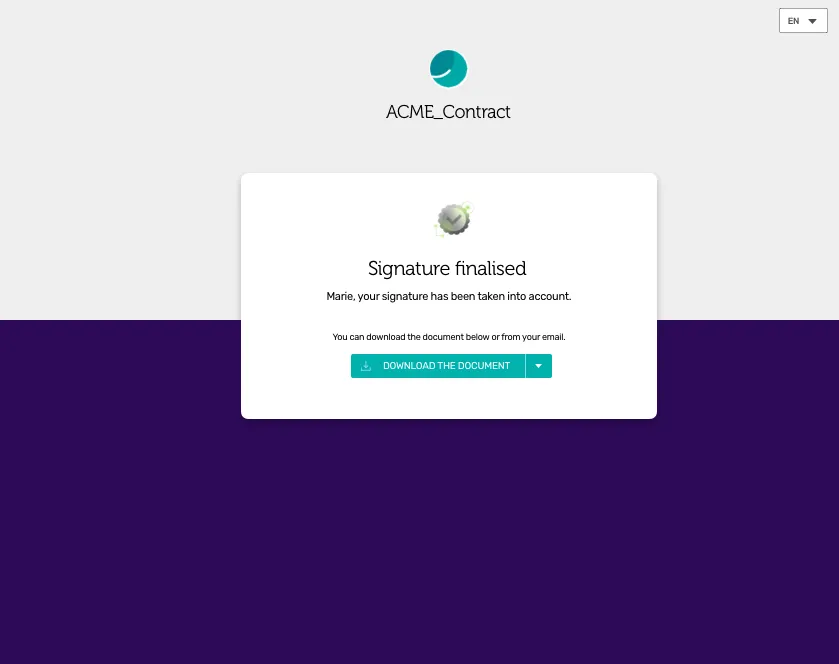 Signature confirmation |
Which teams use it, and for what
Legal departments are the first to benefit, since they can follow a contract from drafting to archiving without leaving the sphere where it was negotiated. HR departments can have employment contracts, amendments and certificates signed by employees who may be far away, while keeping these sensitive documents in France.
In the public sector, the provider’s DGFIP approval makes it easier to sign public procurement documents. Healthcare and social care organisations can have their agreements and data processing contracts signed without the documents leaving the platform. In banking and insurance, signing contracts and amendments with IT providers fits into the third-party risk management requirements of DORA.
Availability
Whaller Signature is available as an option on the Business plan, with no additional subscription to a third-party signing service. Drive 2.0, from which documents are sent for signature, runs on macOS and Windows, with a Linux version in preparation.
Further reading
Whaller Signature: the full presentation
Digital vault: why integrating EDM into a SecNumCloud qualified solution makes all the difference
Whaller Mail: sovereign email integrated into Whaller
Numérique France Garanti: putting an end to unverified sovereignty claims

0 Comments