
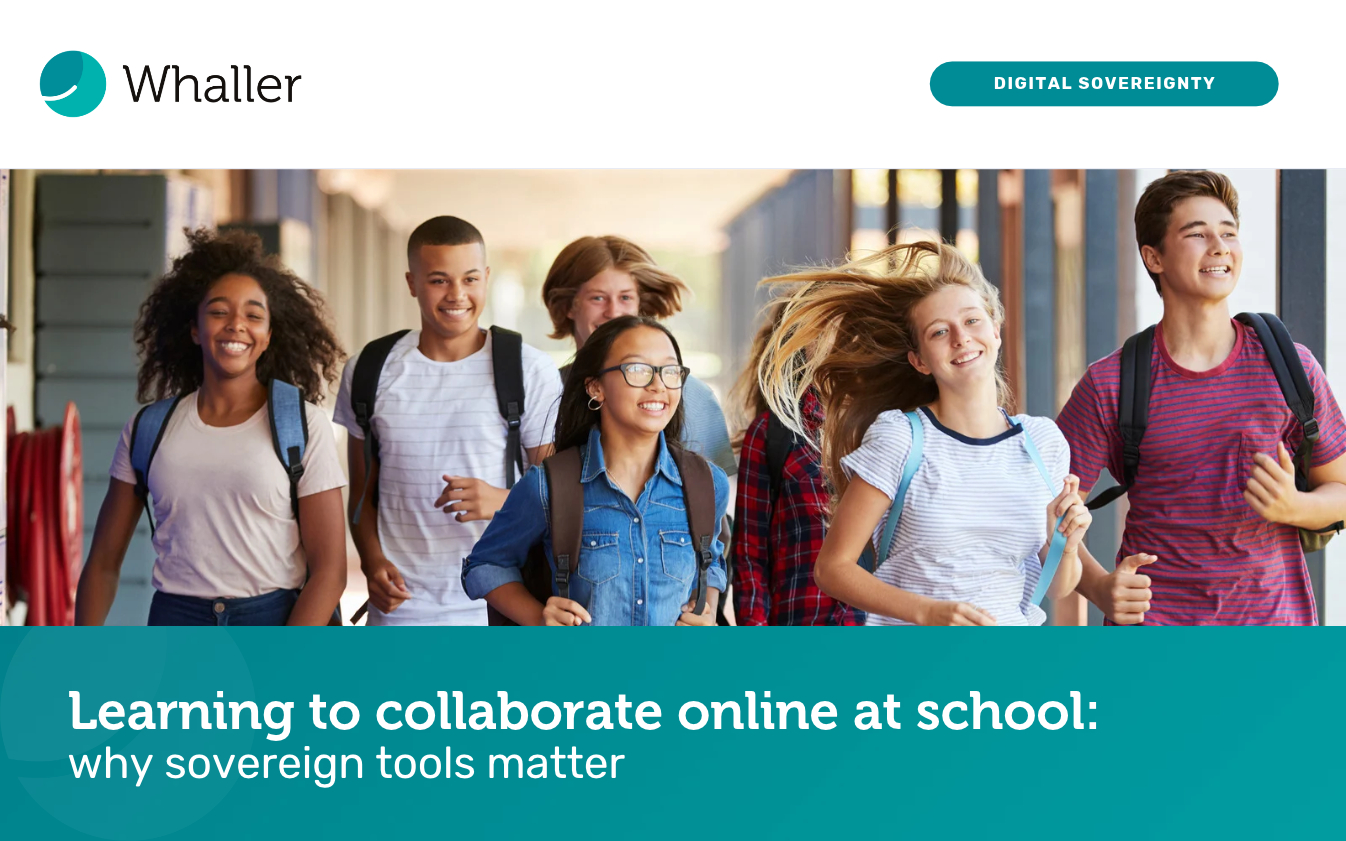
The pupils now at secondary school in France will spend much of their working lives in collaborative tools: team messaging, document-sharing spaces, shared calendars and project tracking. Schools have taken this on board and now treat online collaboration as a skill in its own right. One question, however, is still too rarely asked: on which tools are pupils learning to work together, and what does that choice teach them beyond practical skills?

Digital collaboration has become a school skill
Pix, the French framework used from primary school through to the end of secondary education, assesses sixteen digital skills grouped into five areas, one of which is “Communication and collaboration”. In French secondary schools, this assessment is compulsory in the equivalents of Years 7, 9, 10 and 13, as well as on vocational CAP courses, as Service-Public.fr (in French) points out. Sharing a document, coordinating group work and contacting the right person are therefore all part of what is now expected of pupils by the time they leave school.
The French Ministry of Education’s digital strategy for education 2023-2027 (in French) takes the same line, presenting digital skills as essential to working life, whatever the occupation and level of qualification. Some courses even make it a subject of study: in the penultimate year of the STMG technological stream, which focuses on management and business, the “Management Sciences and Digital Technology” programme devotes an entire unit to digital technology and collective intelligence, examining how information sharing changes the way organisations work.
The tools we learn become the tools we expect
Learning to collaborate online inevitably means learning to do so in a specific tool, with its own menus, gestures and habits. These habits do not disappear when pupils leave school: young employees joining a company or a public body readily ask for the software they already know, and the organisation taking them on often ends up adopting it to make their lives easier.
The choice of tools used in the classroom therefore reaches well beyond the classroom itself. Training an entire generation on the same American suites lays the groundwork for a dependency that will later be found in businesses, local authorities and public services. Conversely, introducing pupils to French and European solutions shows them, in practical terms, that alternatives exist and that they will be able to choose their tools with full knowledge of the facts.
Pupils’ data deserves a proper framework
The issue also concerns the protection of minors. A class’s exchanges, work and calendars are personal data, and those who produce them are rarely old enough to grasp what they are entrusting to a platform. In autumn 2022, in response to a written question from MP Philippe Latombe (in French), the French Ministry of National Education made it known that it did not want the free versions of Microsoft Office 365 and Google Workspace in schools, citing in particular the GDPR and the recommendations of the CNIL, France’s data protection authority, as reported by Siècle Digital (in French).
The 2023-2027 strategy builds on this position: it makes sovereignty one of the principles of the ministry’s information system, requires pupils’ data to be protected in line with the GDPR, and encourages the development of open and sustainable digital commons for education. We explored these issues in more detail in our article on digital sovereignty within the French education system (in French).
Learning on real professional tools, designed and hosted in France
For a collaboration skill to mean something, nothing beats a real-life scenario: a team, an assignment, deadlines, roles to share out and content to have approved. An enterprise social network is particularly well suited to this, since it brings together conversations, files, the calendar and task tracking in one place, exactly as in an organisation. Some teachers already use it in this way, such as a class of business students in Roubaix who recently worked on Whaller to carry out recruitment and communication assignments.
Whaller is designed and developed in France, and its data is hosted by OVHcloud, in France. Schools can create spheres for each class, teaching team or project, and have pupils work in an environment governed by European law, without relying on a solution exposed to extraterritorial American legislation. Pupils pick up the same habits as on any other collaborative tool, with the added discovery that a comprehensive, easy-to-use tool can be French.
Teaching users who will know how to choose
Schools do not just prepare pupils to use digital tools: they also shape the way pupils look at those tools. By introducing them to French and European solutions, schools give them the chance to understand where their data goes, who hosts it and under which rules. These are questions they will ask themselves tomorrow as employees, entrepreneurs or civil servants, and the classroom is where they can learn to answer them.
To find out more, discover how Whaller makes communication between schools and families easier, or how universities create their own secure social network (both in French).



0 Comments