
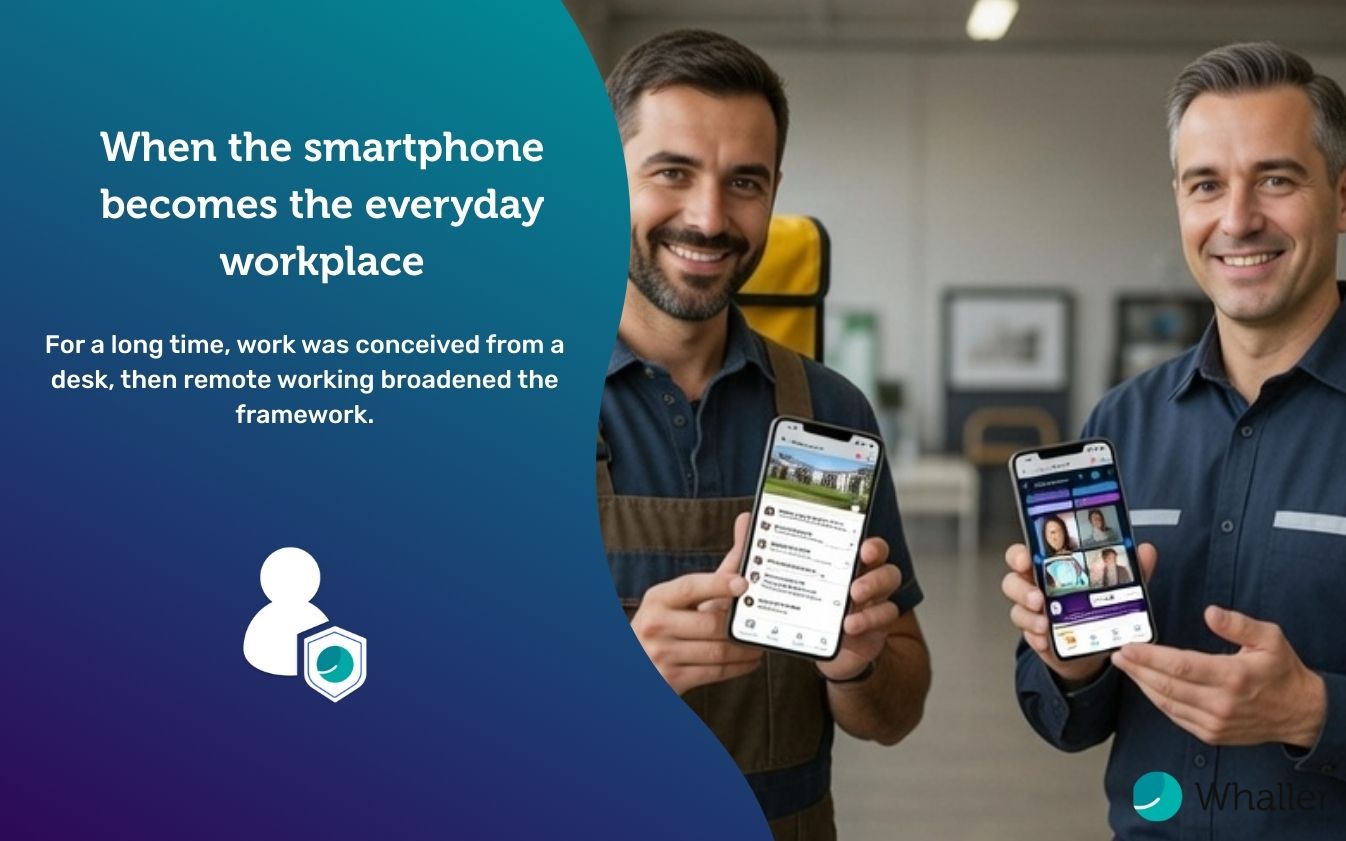
For a long time, work was conceived from a desk, then remote working broadened the framework. But one reality, more discreet yet widespread, never disappeared: that of women and men who work in the field. Craftspeople, drivers, maintenance staff, skilled workers, mobile technicians or public transport operators carry out their work far from fixed screens, in direct contact with customers, users and the constraints of the real world.
For these professionals, digital work does not take place behind a computer, but in a pocket, through a smartphone. And with it come the same expectations as for any other worker: access information, communicate, organise and decide, without unnecessary complexity.
Mobility, long misunderstood by digital tools
Professional digital tools were long designed for sedentary use. Collaborative tools, intranets and communication platforms were built for offices, fixed workstations and continuous connections. Field-based roles had to adapt, often by improvising: a bit of personal messaging, some documents sent by email, informal groups to coordinate — sometimes at the cost of blurring the line between professional and private life.
This situation is not trivial. It forces users to juggle multiple applications, multiple accounts and multiple passwords, without always knowing where information is circulating or who can access it. As the smartphone became the primary work tool, this model clearly showed its limits.
The smartphone as a true workstation
Today, the smartphone is no longer a secondary tool. For many field professionals, it is the main gateway to the digital environment. Instructions, exchanges with the organisation, access to documents, meeting organisation and coordination with partners all flow through it.
What is expected is not a stripped-down version of a tool designed for computers, but full continuity of use. Being able to exchange messages instantly, start or join a video call, access documents, organise a meeting, respond to a poll, publish or consult an announcement — all directly from the mobile application, with the same simplicity and reliability as on a desktop.
This is precisely where environments such as Whaller come into their own. The mobile application does not offer secondary features, but the same working environment, accessible everywhere, at any time.
A single access, a single identity, multiple spheres of life
One of the major challenges of modern digital life is the fragmentation of uses. One application for work, another for family, a third for informal exchanges, a fourth for documents — each with its own account, password and implicit rules.
By contrast, Whaller is built on a simpler, more human logic: one identity, but several clearly separated spaces. With the same access, a user can securely exchange with colleagues, take part in a professional meeting, consult work-related documents, then switch, in another watertight space, to exchanges with children, partners or parents.
This separation between organisations and spheres of life is not a technical detail. It prevents contexts from being mixed, preserves the confidentiality of professional exchanges and maintains a clear boundary between work and personal life, without having to change application or account.
Communicate, organise, decide… simply
In the field, time is scarce. Tools must focus on what matters. An instant message to ask a question or pass on information, a video call to exchange quickly without travelling, a document accessible at the right moment, a poll to make a simple decision, an announcement to share useful information.
The value of a single environment lies precisely there: not having to wonder where to do what. Exchanges, documents and decisions are all in the same place, within a clear, understandable and secure framework. What can be done from a computer can also be done from a smartphone, without disruption or loss of meaning.
Mobility as an infrastructure of trust
As work moves beyond the walls of the organisation, trust becomes central. Trust in the information received, in the documents consulted, in the confidentiality of exchanges. For organisations, it is also about ensuring that professional data does not disperse across unmanaged tools.
Thinking of mobility as an infrastructure of trust addresses these challenges. It requires clear compartmentalisation of spaces, fine-grained access management and governance of exchanges that does not rely on consumer tools diverted from their original purpose.
In this context, the standard version of Whaller, available free of charge, also plays a key role. It offers users a secure, sovereign environment for messaging, video conferencing and content sharing, with no exploitation of personal data. A kind of “messaging on steroids”, but designed to bring people closer together, not to capture their attention.
Digital as an enabler, not a constraint
Banking apps have simplified money management, transport apps have streamlined journeys, and travel tools have made routes clearer. They succeeded because they understood one essential thing: digital technology should simplify life, not complicate it.
The same applies to field work. Offering mobile professionals a single digital environment, accessible from their smartphone, secure, coherent and respectful of their practices is not about adding another layer of technology. It is about removing complexity.
When digital tools achieve this, they stop being a constraint. They become a link. A link between the field and the organisation, between professionals and their loved ones, between individuals and organisations. And that is precisely what digital technology should always be about: bringing people closer together, for real.
0 Comments