
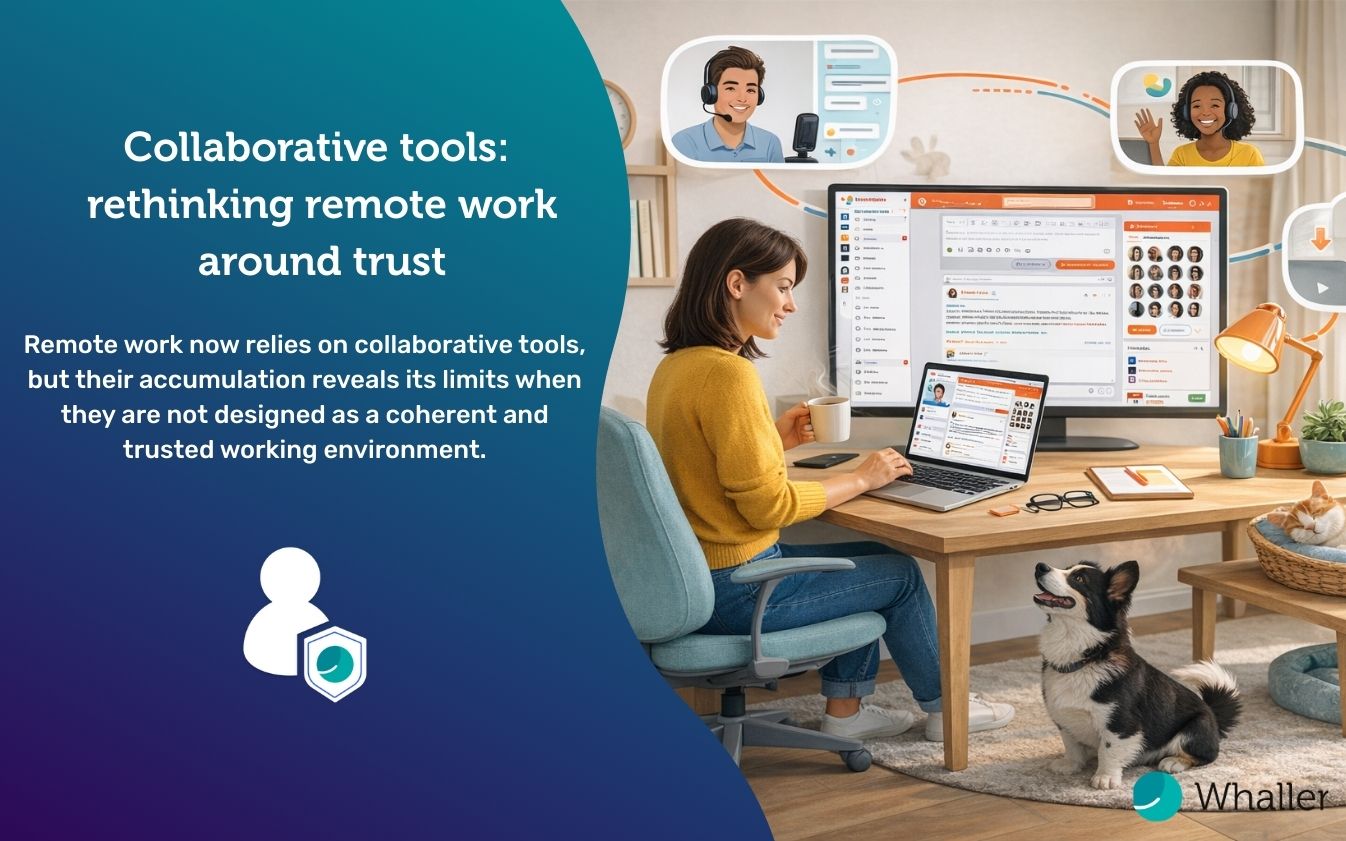
Remote work now relies on collaborative tools, but their accumulation reveals its limits when they are not designed as a coherent and trusted working environment.
Remote work has taken hold quietly. It was not announced as a revolution; it simply became established through everyday practices, organisational constraints and profound transformations in the world of work. Today, most teams no longer ask whether they should work remotely, but how to do so without losing efficiency, clarity and the quality of collaboration.
Despite the abundance of available tools, a sense of unease remains. Exchanges multiply, documents circulate, meetings follow one another, and yet the feeling of dispersion persists. Many people feel they spend more time searching for information, reconstructing context or checking decisions than actually making progress.
This paradox is revealing:
the problem with remote work is not a lack of communication, but a disorganisation of collaboration.
When collaboration was reduced to a sum of features
For a long time, collaboration was approached as a simple set of features: chatting, sharing, planning. Tools were stacked to address these specific needs — a messaging tool to exchange quickly, a drive to store files easily, a videoconferencing tool to meet without constraints, and another to manage tasks efficiently.
Over time, collaboration became fragmented. Exchanges lost their context, decisions were scattered across conversation threads that were impossible to revisit, and documents circulated without anyone always knowing which version to trust. Yet working remotely requires precisely the opposite: restoring an explicit framework to what, in face-to-face settings, used to be taken for granted. Knowing where discussions take place, with whom, within what scope and according to which rules. Without this, collaboration becomes a continuous noise — tiring and unproductive.
It is at this point that some platforms take a radically different direction. Rather than adding functional building blocks, they seek to reconstruct a genuine digital working environment, structured around clear, coherent and controlled spaces.
Restoring context to exchanges to regain clarity
In a structured collaborative environment, exchanges do not float in an indistinct stream. They take place within precise frameworks that reflect the reality of work: a team, a project, a partnership, a community. This logic lies at the heart of platforms such as Whaller, which organise collaboration around autonomous, compartmentalised spaces.
This structural choice profoundly changes the way teams collaborate remotely. Discussions become clearer, decisions easier to read, and documents regain their natural place. A file is no longer an isolated object moving from one tool to another; it is tied to a specific context, a discussion, a project. Information no longer needs to be hunted down — it is found where the work actually took place.
This structuring also relies on a clear distribution of roles and responsibilities. Knowing who animates a space, who can invite others, who publishes or moderates is not an administrative constraint, but a condition for smooth collaboration. In remote settings, the absence of an explicit framework often creates grey areas that lead to tension or inefficiency. Conversely, clear and shared rules allow everyone to focus on their work without constantly wondering how the tool works.
Collaborative sovereignty, a new challenge for remote work
As work becomes increasingly dematerialised, collaboration becomes the place where the most sensitive information is concentrated: strategic decisions, operational exchanges, partnerships and internal knowledge. The question is therefore no longer simply whether a tool is convenient, but whether it provides a lasting framework of trust.
It is in this context that the notion of collaborative sovereignty emerges. It is not limited to data hosting or technical security; it encompasses the ability to control collaborative spaces, to compartmentalise uses, to integrate external stakeholders without exposing the entire system, and to ensure that the rules remain under the organisation’s control.
In other words, collaboration ceases to be a simple usage and becomes a full-fledged working infrastructure, on a par with email or networks. An infrastructure chosen not for fleeting trends, but for its ability to stand the test of time.
Working remotely without giving up trust
Collaborating remotely means being able to share without fear, to exchange without losing control, and to work without unnecessarily exposing sensitive information. When these guarantees are built natively into the working environment, they cease to be daily concerns and give way to what really matters: the work itself.
This structural trust is all the more important as organisations increasingly work with external partners, service providers or extended communities. Without a clear framework, this openness becomes a risk. With a controlled environment, it becomes a strength.
Preserving attention in a world saturated with interruptions
Another major challenge of remote work is often less visible, but just as decisive: the protection of attention. Constant notifications, multiple requests and messages taken out of context fragment teams’ time and energy. Over the long term, this overload undermines the quality of decision-making and professional well-being.
Collaborative environments designed as coherent infrastructures, on the contrary, seek to channel flows, limit unnecessary interruptions and restore continuity to work. By structuring exchanges rather than multiplying them, they help preserve what is becoming increasingly scarce: the ability to concentrate, to think and to decide.
When the tool stops being just a tool
Ultimately, the most useful collaborative environments are rarely the ones that are talked about the most. They are those that know how to fade into the background to make room for real work, meaningful exchanges and decisions that matter. When a digital environment manages to structure without constraining, to secure without rigidifying and to connect without dispersing, it stops being just another tool. It becomes a place where people feel comfortable working. And it is often at that moment, almost without noticing, that teams find themselves working better together.



0 Comments