
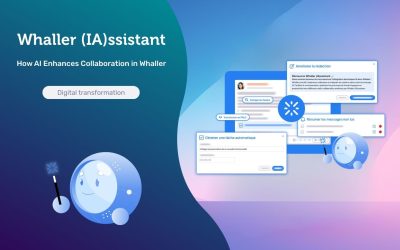
How AI Enhances Collaboration in Whaller
Collaborative platforms have become essential to the day-to-day running of organisations. Yet with the ever-growing volume of discussions, documents and notifications, maintaining a clear overview can be a real challenge. The integration of artificial intelligence...
The MCP Server Simply Explained
Connecting AI to Your Collaborative Platform Artificial intelligence becomes truly useful when it can interact with an organisation's working tools. That is precisely the purpose of the MCP server (Model Context Protocol) integrated into Whaller. This...

Automatic meeting minutes: When AI turns your video conferences into actionable decisions
Le compte-rendu automatique de réunion : quand l'IA transforme vos visioconférences en décisions actionnables In many organisations, meetings are essential… but following up on them is often tedious. Who writes the minutes? Who notes the decisions? Who turns...

Digital Workplace: the end of the intranet and internal email
Monday morning, 8:47am. Marie, HR Director of a 600-person mid-sized company, opens her inbox to find 94 new messages since Friday. Among them: a leave request, an HR process validation, a version 7 of a document she can no longer find version 6 of, and three "reply...

Social Engineering 2.0: when AI gets involved, how to outsmart these scams
Imagine this: your manager calls you, the familiar voice urgently requesting a wire transfer. Hard to refuse… Yet that voice may have been synthesised by artificial intelligence. Welcome to the era of Social Engineering 2.0, where voice deepfakes, manipulated videos...
Has the Password Become the Weak Link in Digital Collaboration?
For years, IT security came down to a simple rule: choose a complex password and never share it. This logic long seemed sufficient — today, it is looking increasingly fragile. Phishing, account compromise, automated attacks, identity theft… Recent security incidents...