
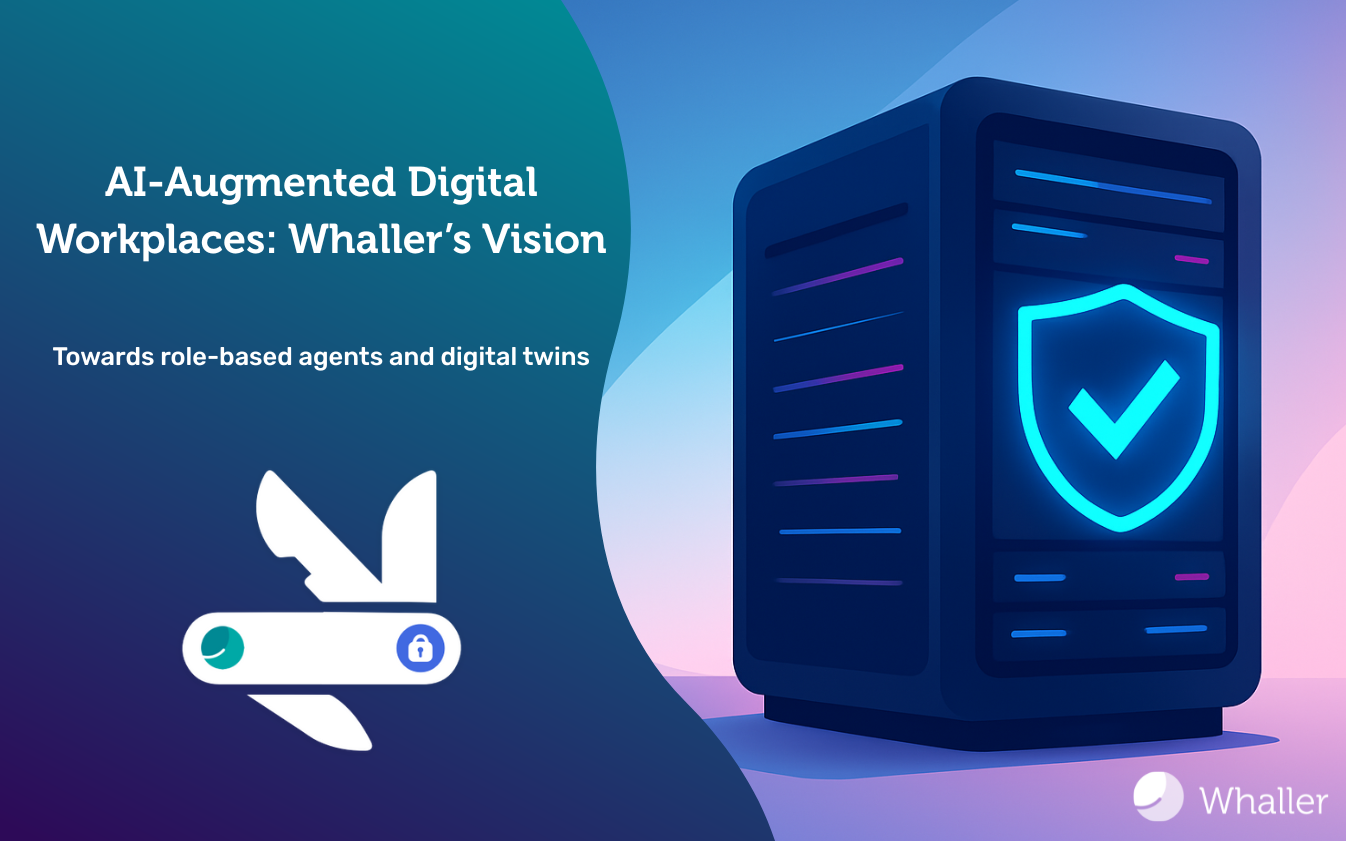
Digital collaboration tools are experiencing a new acceleration driven by artificial intelligence (AI). After the era of intranets and enterprise social networks, the focus has shifted to unified digital workplaces, enhanced by intelligent agents capable of supporting teams in their day-to-day work. This evolution, analysed by experts such as Fred Cavazza, pursues a clear objective: freeing employees from repetitive tasks and moving beyond the traditional “meetings / emails / files” paradigm that still hinders productivity. Generative AI is thus paving the way for digital work environments where humans and virtual agents work side by side, each focusing on what they do best.
Embedding AI at the heart of everyday tools
While the capabilities of AI models continue to impress, the real transformation lies in their integration into existing business tools. The challenge is no
longer to build the most powerful standalone agent, but to deploy it directly within employees’ working ecosystem. There is no need to leave an application to consult an external chatbot: the virtual assistant operates where your files, messages and processes already reside. This contextual integration is key to widespread adoption, as users are generally reluctant to radically change their habits.
Major software vendors have clearly understood this by embedding AI into their suites (Microsoft 365 Copilot, Google Workspace with Duet AI, etc.), introducing the concept of hybrid teams that combine humans and digital agents. These “synthetic colleagues” take part in conversations, prepare reports or automate tasks, much like new virtual co-workers. In the longer term, we are even seeing the emergence of digital twins for each employee or key process, capable of representing a person in a meeting or automatically handling routine activities. This scenario may seem futuristic, yet it is already taking shape: what current agents lack is access to the right enterprise data to operate effectively. Hence the importance of connectors and open APIs that allow AI to integrate seamlessly with our work tools.
Whaller natively integrates AI into its platform
Aware of these challenges, Whaller has taken a major step forward by offering native AI integration within its collaborative platform. Since December 2025, Whaller has been the first French digital workplace to provide an AI connector based on the open standard Model Context Protocol (MCP). In practical terms, this means you can directly connect an intelligent assistant (such as ChatGPT, Claude, etc.) to your Whaller spaces and involve it in your activities: the agent can read messages, post in discussion spheres, or automate workflows, all in a transparent and real-time manner.

This approach creates no parallel tools: AI operates directly within the Whaller platform, in your usual spheres. Every action performed by a virtual agent strictly complies with the existing security, permission and confidentiality rules. In other words, AI only accesses the information the activating user is entitled to, and all its actions are fully visible in the standard activity feed. The objective is clear: innovate without ever compromising control and trust. This carefully managed integration offers organisations the best of both worlds – AI-driven efficiency gains on one side, and governance and digital sovereignty on the other. Whaller delivers these new services in line with its core principles (hosting in France, data isolation, SecNumCloud qualification), ensuring AI can be adopted safely within your digital environment.
Virtual assistants to support your teams
What does an AI assistant integrated into Whaller bring to your teams on a daily basis? Here are a few examples of enabled capabilities and use cases:
- Instant access to information – The agent can browse your spheres and content to extract relevant insights in context: unread messages, task lists, upcoming events, and more. No need to manually search—AI provides a clear, synthesised overview.
- Automated actions within your spaces – AI can publish a summary message in a sphere, add a reaction to mark a post as processed, or initiate a discussion thread on a given topic, all through its own programmed initiative. Your collaborative spaces remain active and up to date with minimal effort.
- Time savings and proactivity – By automating repetitive tasks, the agent acts as a digital teammate that saves you time. For example, it can generate a daily briefing summarising your tasks, upcoming meetings and priority messages. It can also compile a weekly internal newsletter based on content shared across your spheres, highlighting key updates and achievements. Routine work handled in seconds by AI, freeing your teams to focus on higher-value activities.

These scenarios clearly illustrate the promise of an AI-augmented digital workplace: “leveraging AI to facilitate and stimulate collaboration in order to boost productivity and creativity.” AI does not replace your existing tools; it enhances them, making them smarter and more responsive. Instead of multiplying applications, you rely on a unified platform where the virtual assistant becomes a full-fledged team member. Early deployments at Whaller already demonstrate that AI can act as a reliable virtual colleague, supporting teams without disrupting organisational structures.
Towards role-based agents and digital twins
The journey is only just beginning. In the near future, Whaller plans to go even further by introducing role-specific AI agents across its offering. This means each department—communications, human resources, project management, support—will be able to rely on a specialised virtual assistant that understands the specific challenges of its domain. For instance, an HR agent could automate employee onboarding or answer frequently asked questions, while a project agent could support project managers with task and milestone tracking. Gradually, this brings us closer to the concept of a digital twin for certain business functions: an AI that understands processes and data well enough to operate with near autonomy on routine tasks.
This vision aligns with that of major industry players, who foresee virtual collaborators becoming ubiquitous in tomorrow’s organisations. However, it is now becoming accessible to organisations of all sizes thanks to open and well-controlled solutions. As Fred Cavazza explains, the rapid progress of AI means that “everything described here is already possible. All that is needed is access to the right data sources.” Whaller’s MCP connector provides precisely this controlled access to your platform’s data and actions, without complex development. You remain in control of what the agent does, while enabling it to orchestrate your tools effectively. In other words, Whaller already empowers organisations to build human–AI hybrid teams within a trusted framework—a decisive advantage for entering the next phase of digital transformation.
Are you ready for the Digital Workplace of tomorrow?
AI-augmented work environments are no longer science fiction; they are already emerging around us. And the challenge is not humans versus machines, but using technology to eliminate low-value tasks and inefficient habits. “Any solution that helps us move beyond the meetings/emails/files paradigm is worth considering,” Fred Cavazza reminds us. Integrating intelligent AI into your digital workplace is clearly part of that solution. Thanks to innovations like those introduced by Whaller, this opportunity is available today—without disruptive change and while meeting your security requirements. The real question, then, is this: are your teams ready to welcome their new virtual colleague?
0 Comments