
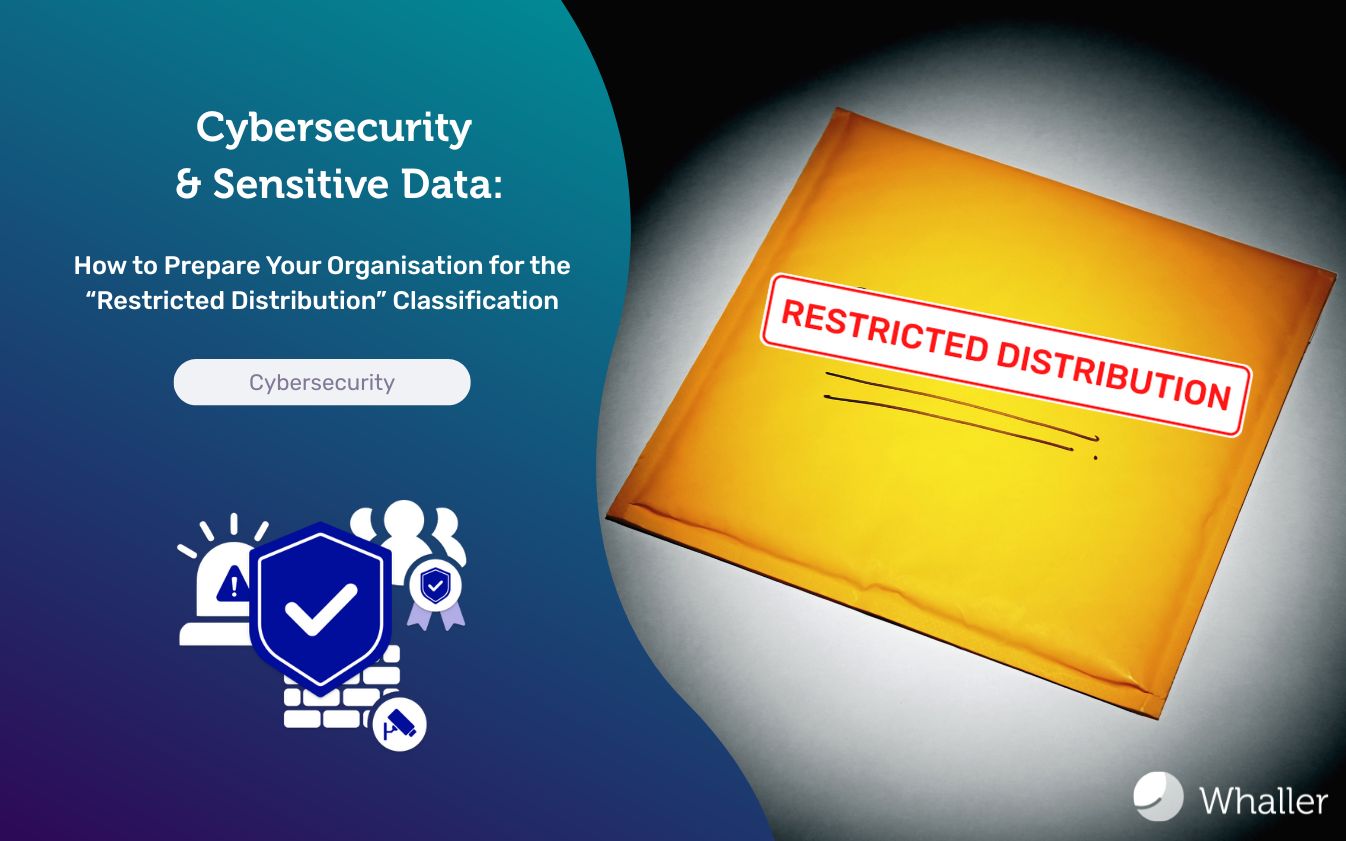
As cyber threats continue to rise and the sensitivity of data handled by public and private organisations increases, France has established an official framework to protect what it calls “restricted distribution” (DR) information.
But what does DR actually mean for a CIO or CISO? What obligations does it imply? What impact does it have on the collaboration tools used daily? And how can organisations anticipate compliance?

Restricted Distribution: an intermediate category of sensitive data
The “Restricted Distribution” classification designates a level of sensitivity for information which, while not part of national defence secrecy, must be strictly protected against unauthorised disclosure.
According to official guidance issued by French authorities, such data may relate to strategic, economic, technical, organisational or operational matters. Their compromise could undermine the effectiveness of public action, the safety of a company, or the competitiveness of a service.
This classification is distinct from levels such as, “Secret” or “Top Secret”: whereas these belong to national defence doctrine, DR targets sensitive information systems and collaborative uses within a civil or semi-public framework (source: SGDSN).
A need for concrete solutions in collaboration tools
Today, business units have widely adopted cloud-based collaboration tools. Yet very few of them are truly suitable for handling Restricted Distribution-classified data.
Why? Because this requires:
- Full control of the trust chain: from physical infrastructure to the software layer.
- Exclusive hosting in France, with providers not subject to extraterritorial laws.
- High-level security guarantees: segmentation, logging, restricted access, encryption, separation of environments, etc.
- European governance, free from capitalistic or operational ties to foreign powers.
- Rigorous data classification, visible labelling, and strictly “need-to-know” access.
- Integration of technical safeguards such as: Data Loss Prevention (DLP), Identity and Access Management (IAM) with strong authentication, ANSSI-compliant encryption, logging and incident monitoring.
- A security policy embedded in a broader strategy including strong governance, proactive risk management, resilient architecture, incident response plans and continuous improvement.
The Whaller response: a trusted environment for Restricted Distribution-classified data
Whaller offers a European, secure, SecNumCloud-qualified alternative designed to meet Restricted Distribution requirements. The platform combines:
- A segmented software architecture (spheres), ensuring full control over data flows.
- Hosting in France on SecNumCloud-qualified cloud infrastructure.
- Native compatibility with the security policies of administrations and sensitive operators.
- Independent governance, 100% French, free from extraterritorial influence.
- Comprehensive support for Restricted Distribution compliance: data classification, flow mapping, definition of roles and responsibilities, logging and regular audits.
- A capacity to transform the accreditation process into a driver of resilience and continuous improvement.
An opportunity to anticipate and support operational needs
Instead of suffering regulatory pressure, CISOs can use the Restricted Distribution framework as a transformation lever:
- Structure a finer data classification policy aligned with Restricted Distribution requirements and the need-to-know principle.
- Accelerate the security of collaborative and mobile uses by integrating DLP, IAM, encryption, logs, etc.
- Provide business teams with tools adapted to their real needs for sharing and confidentiality, while maintaining governance and traceability.
- Establish a shared security culture: training, awareness, clear responsibilities (CISO, data owners, users) as outlined in the Restricted Distribution doctrine.
- Implement audits and penetration tests and ensure continuous improvement to maintain protection against leaks or compromises.
The Restricted Distribution classification thus becomes a catalyst for cybersecurity best practices.
Towards a shared culture of security
With Restricted Distribution classification, it is not simply a matter of ticking a box. Working with sensitive data requires true cybersecurity maturity: clear policies, defined roles and responsibilities, processes, technical measures, auditing, governance and continuous improvement.
Whaller can support public and private organisations through this transition: from selecting the right tool to accreditation, including user training and governance implementation. Cybersecurity is not merely a technical solution but a trusted ecosystem, operated, controlled and governed in line with French and European interests.
Why traditional solutions are not enough
Generic collaboration suites, mostly American, cannot meet these requirements: they are subject to extraterritorial jurisdictions such as the Cloud Act, rely on infrastructure outside European control, and do not guarantee national governance over sensitive data.
As the SGDSN reminds us, failure to comply with Restricted Distribution prerequisites may have legal consequences for administrations or companies concerned.
In a context of increasing cyber threats and geopolitical tension, the Restricted Distribution classification requires organisations to adopt a rigorous framework for digital protection and resilience. By anticipating requirements, relying on sovereign solutions (such as Whaller) and implementing appropriate governance, they ensure not only compliance but also performance and trust among stakeholders.



0 Comments