
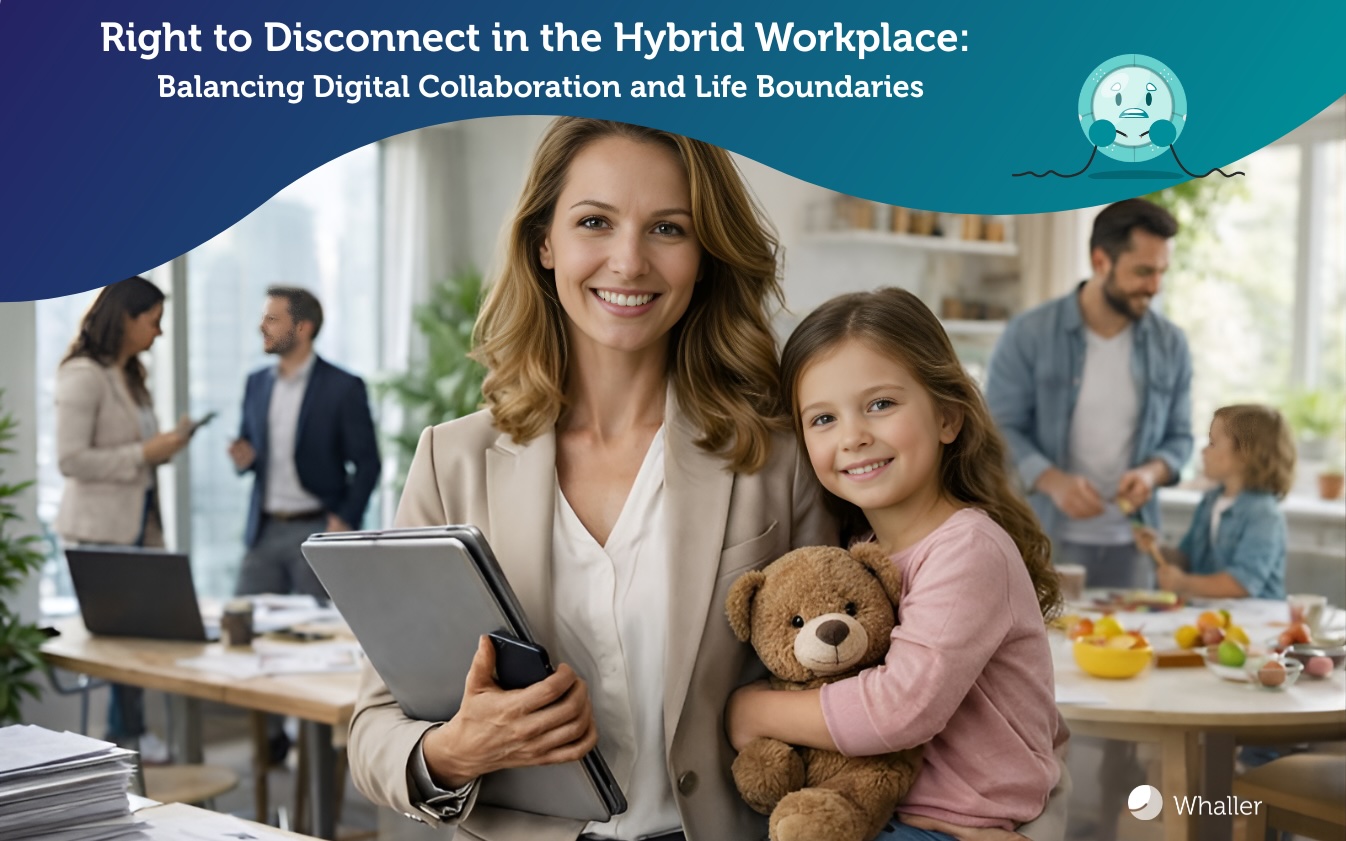
Hybrid working, instant messaging and all-in-one collaboration tools have blurred the line between work and personal life across the United Kingdom. With notifications competing for attention at all hours and teams operating asynchronously, the “always-on” culture has become a growing concern for both organisational performance and employee wellbeing.
How can we preserve healthy life boundaries in a fast-moving digital workplace? And how can organisations support collaboration without fuelling digital fatigue? Platforms such as Whaller are addressing these challenges by combining secure collaboration with digital sovereignty, without adding unnecessary hyperconnectivity.
Whaller is not limited to large enterprises: it is available in a standard offer for the general public and can also be tailored to SMEs, mid-market companies, large corporates and public sector institutions (local authorities, departments, regions, ministries, etc.).
The Right to Disconnect: UK Context and Key Issues
Unlike France, where the right to disconnect has been enshrined in law since 2017, the United Kingdom currently has no statutory “right to disconnect”. The topic is instead covered through hybrid working policies, wellbeing frameworks, duty of care obligations and recommendations from bodies such as the CIPD and ACAS.
The aim is not to limit flexibility or remote work, but to reduce cognitive overload, protect rest periods and prevent digital burnout linked to constant stimulation and fragmented communication flows.
The Risks of an Always-On Culture
Digital overload manifests in the workplace through:
- constant notifications, including outside traditional working hours,
- increased messaging volume across multiple channels,
- a proliferation of disconnected communication tools.
According to the Microsoft Work Trend Index 2025, employees receive an average of more than 100 emails and 150 collaborative tool messages per day, contributing to digital fatigue and boundaryless work.
Digital Workplace, Employer Brand and Internal Communication
;
Digital Workplace as an Employer Brand Asset
The employer brand reflects the image an organisation projects as an employer and directly influences its ability to attract, retain and engage talent. A well-designed collaborative platform strengthens this positioning by centralising communication channels, reducing friction and improving access to information.
A platform such as Whaller, bringing together conversations, documents, projects and communities in a secure and structured environment, reinforces the perception of a modern workplace that values wellbeing, clarity and autonomy.
A Key Tool for Communication Teams
Communication and marketing teams often face fragmented tool ecosystems (CRM, office suites, messaging platforms, social media), resulting in duplicated work, slower coordination and complex workflows. An integrated platform centralises information, unifies exchanges and streamlines collaboration — reducing frustration and improving productivity, particularly in hybrid working environments.
Protecting sensitive information (strategic content, messaging, data) is also critical. A collaborative platform with encryption and reinforced authentication reduces confidentiality risks and improves knowledge access.
Best Practices for Healthy Digital Collaboration
To balance collaborative performance with the right to disconnect, organisations need to align culture, management practices and technology choices:
- Introduce a digital usage policy defining availability windows, communication channels and urgency rules.
- Reduce notifications outside working hours and offer “focus” modes to limit interruptions.
- Train managers to lead by example (avoid late messages, encourage “time off”).
Selecting appropriate tools also helps reduce communication overload (fewer emails, more targeted and structured messages).
Whaller: A Sovereign, Accessible and Secure Digital Workplace
Whaller is a modular collaborative platform designed to centralise communication, documents, tasks and interactions within a secure and sovereign environment, hosted in France and compliant with the GDPR. It is suitable for both private users and organisations of all sizes, including the public sector.
Why This Approach Matters
- Tool centralisation:
eliminating digital silos through a single platform for messaging, planning, file sharing and project coordination. - Unified communication: reducing internal email volume and unnecessary interruptions.
- Customisable spaces: enabling the creation of team-specific, project-specific or community-specific workspaces.
- Whaller (AI)ssistant: AI features generate summaries, task suggestions and writing assistance without exploiting user data.
For organisations dealing with sensitive data or strict compliance requirements, Whaller offers Whaller DONJON, the version qualified SecNumCloud by ANSSI, ensuring maximum trust in regulated environments.
Digital Sovereignty and Performance
Digital sovereignty goes beyond data protection: it has become a lever for organisational performance, as demonstrated by several studies integrated into the Whaller ecosystem:
- -25% internal emails through communication centralisation (McKinsey).
- +17% project efficiency (Forrester).
- +21% employee satisfaction (Microsoft Work Trend Index).
- +32% faster decision-making (Deloitte).
These results show that a well-designed digital workplace can enhance collaboration, protect rest periods and improve employee engagement.
Towards a More Human-Centred Digital Environment
The right to disconnect is not merely a legal topic: it is a prerequisite for sustainable performance, wellbeing and talent attraction. A sovereign, integrated and ergonomic digital workplace such as Whaller helps structure communication flows, reduce information overload and support quality of life at work while improving collective efficiency.
To learn more:
0 Comments